

Table of contents:
- Google Cloud Platform: From Cloud Infrastructure to AI Agents
- Three Service Models Offered by GCP
- Compute and Application Services
- Storage and Data Analytics Services
- Important Update: Vertex AI Evolves into Gemini Enterprise Agent Platform
- Quick Comparison: Core GCP Services
- Benefits of Choosing GCP for Business Needs
- Analysis: Why This Shift to an Agent Platform Matters
- FAQ
Google Cloud Platform: From Cloud Infrastructure to AI Agents
GCP is more than just a place to store data — since 2026, Google has transformed the core of its AI services into a much more integrated agent platform.
Google Cloud Platform (GCP) is a suite of cloud computing services developed by Google for building, running, and managing applications without having to own physical infrastructure. Instead of purchasing and maintaining their own servers, businesses and individuals can rent computing capacity, storage, networking, and artificial intelligence capabilities directly from Google’s global infrastructure — and pay only for what they use. This article covers the fundamentals of GCP, its key services, and the major changes to its AI platform throughout 2026, so your understanding stays relevant to the current landscape.
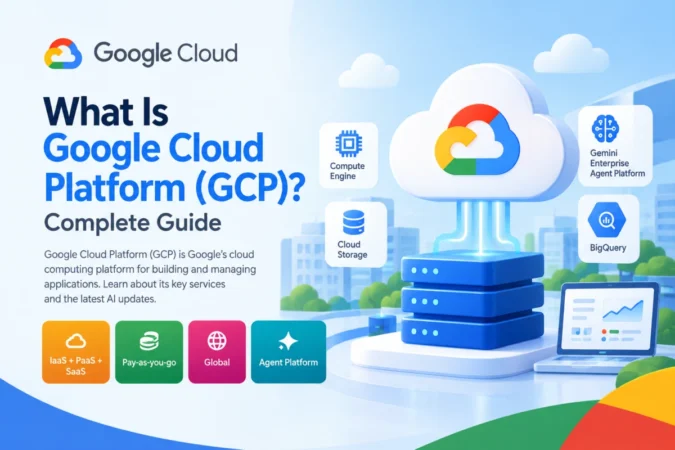
IaaS + PaaS + SaaSThree service models in one ecosystem
Pay-as-you-goPay based on usage, without hardware investment
GlobalRuns on Google’s global network infrastructure
Agent PlatformNew AI foundation replacing Vertex AI since April 2026
Three Service Models Offered by GCP
GCP provides three complementary cloud computing service models. Infrastructure as a Service (IaaS) provides access to fundamental computing resources such as virtual machines and storage, giving users full control over server configuration. Platform as a Service (PaaS) provides a ready-to-use environment for developing and running applications without having to manage the underlying infrastructure. Software as a Service (SaaS) consists of ready-to-use applications such as Google Workspace. All three operate within an integrated ecosystem, allowing users to choose the right balance of control and convenience for their project needs.
Compute and Application Services
- Compute Engine — runs fully customizable virtual machines (VMs), making it suitable for workloads that require complete control over the operating system and configuration.
- App Engine — a managed platform for building and deploying web applications without managing servers, supporting a range of popular programming languages.
- Google Kubernetes Engine (GKE) — an open-source Kubernetes-based container orchestration service that simplifies management of large-scale applications running across multiple containers.
- Cloud Run — a serverless platform for running containers without managing a cluster, making it suitable for applications with fluctuating traffic.
Storage and Data Analytics Services
- Cloud Storage — object storage for images, videos, and other files with high redundancy to keep data secure and readily accessible.
- Cloud SQL — a managed relational database supporting MySQL, PostgreSQL, and SQL Server without requiring manual patching or backups.
- Cloud Bigtable — a high-performance NoSQL database for very large-scale data, such as real-time analytics or machine learning workloads.
- BigQuery — a serverless data warehouse capable of rapidly processing queries at petabyte scale without managing physical servers.
- Looker Studio — a data visualization and reporting tool (formerly known as Google Data Studio) that connects directly to BigQuery and other data sources to create interactive dashboards.
“What has changed is not just the service name — Google Cloud’s AI development direction has fully shifted to the new platform, and the older version no longer receives new features.”
Important Update: Vertex AI Evolves into Gemini Enterprise Agent Platform
One of the most significant changes in the GCP ecosystem occurred at Google Cloud Next 2026: Vertex AI, Google Cloud’s flagship machine learning platform since 2021, officially evolved into Gemini Enterprise Agent Platform. This is not simply a rebranding — the new platform combines Vertex AI’s model selection, training, and model tuning capabilities with new features for building, orchestrating, and managing AI agents end to end, including Agent Studio, Agent Registry, Agent Identity, and Agent Gateway. Google states that future feature development will be released through this new platform rather than as standalone Vertex AI updates, so anyone still using older Vertex AI SDK modules should pay attention to Google’s official migration schedule.
Quick Comparison: Core GCP Services
| Service | Category | Main Function |
|---|---|---|
| Compute Engine | IaaS | Fully customizable virtual machines |
| App Engine | PaaS | Deploy web applications without managing servers |
| Cloud Storage | Storage | Store files/objects with high redundancy |
| BigQuery | Data Analytics | Query petabyte-scale data without physical servers |
| Gemini Enterprise Agent Platform | AI/Machine Learning | Build, train, and manage AI agents (evolution of Vertex AI) |
Benefits of Choosing GCP for Business Needs
- High performance and global networking — leverages the same Google network infrastructure used by Search and YouTube, helping applications remain responsive even under heavy traffic.
- Flexible scalability — autoscaling and managed services allow businesses to increase or decrease capacity as needed without upfront hardware investment.
- Layered security — data encryption, identity-based access control (IAM), and compliance with various international security standards.
- Pay-as-you-go pricing model — businesses pay only for actual usage, with a pricing calculator available for budget simulations before implementation.
- Native AI integration — through the Gemini Enterprise Agent Platform, businesses can build custom AI agents connected directly to their operational data in BigQuery and Cloud Storage.
For technical documentation, the latest pricing, and free trials, visit cloud.google.com or learn more about the evolution of the AI platform on the official Gemini Enterprise Agent Platform page.
Analysis: Why This Shift to an Agent Platform Matters
The consolidation of Vertex AI into the Gemini Enterprise Agent Platform reflects a broader shift across the cloud industry — not just at Google. Other major cloud providers are moving in the same direction: building centralized platforms to manage the lifecycle of AI agents rather than standalone machine learning models. For businesses evaluating or already using GCP, this means future AI adoption strategies should be designed around the agent platform from the outset rather than older services that no longer receive feature updates. For individuals who are new to cloud computing, understanding this change is important so that learning resources and documentation do not point to services that have already been replaced.
FAQ
Is Google Cloud Platform the same as Google Drive or Gmail?
No. Google Drive and Gmail are part of Google Workspace (productivity tools for end users), while GCP is a cloud infrastructure and services platform for developers and companies that want to build and run their own applications.
Can Vertex AI still be used after the Gemini Enterprise Agent Platform was introduced?
Vertex AI’s core capabilities (model selection, training, and tuning) remain available, but they are now part of the Gemini Enterprise Agent Platform. Future feature updates will be released through the new platform, so existing users are advised to begin migrating according to Google’s official schedule.
What is the difference between Looker Studio and Looker?
Looker Studio is a free or lightweight paid data visualization tool (formerly Google Data Studio), while Looker is a more comprehensive enterprise business intelligence platform with the LookML semantic model, now fully integrated as part of Google Cloud.
Is GCP suitable for small businesses or SMEs?
Yes, especially because the pay-as-you-go model does not require a large upfront infrastructure investment. Small businesses can start with basic services such as Cloud Storage or App Engine and increase capacity as the business grows.
How do I get started with GCP?
Google provides a free trial with initial credits for new accounts. Users can sign up directly at cloud.google.com, choose the services they need, and follow the official documentation or certification paths to learn more about implementation.
Conclusion
Google Cloud Platform remains one of the leading cloud computing options thanks to its combination of global infrastructure, the flexibility of IaaS/PaaS/SaaS models, and usage-based pricing. Two aspects of older knowledge should be updated: “Data Studio” is now officially called “Looker Studio”, and more significantly, Vertex AI evolved into the Gemini Enterprise Agent Platform in April 2026 as the new foundation for AI development on Google Cloud. For anyone evaluating GCP for business needs or application development, understanding the direction of the agent platform is important so that cloud and AI adoption strategies do not fall behind the architectural changes taking place across the industry.