Table of contents:
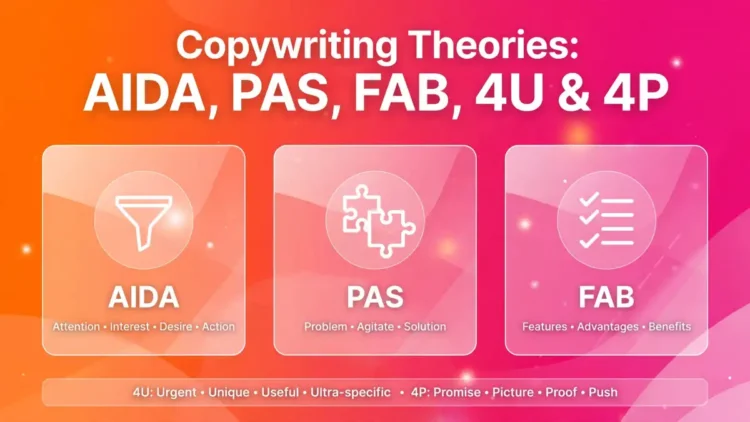
Effective copywriting rarely comes from random inspiration — most of it follows frameworks that have been tested for decades. This article summarizes the most important copywriting theories, from the most classic to the most relevant for modern social media.
120+ yearsAIDA framework age, still widely used
5 frameworksAIDA, PAS, FAB, 4U, 4P
Promise-Picture-Proof-PushCorrect order of the 4P framework
AIDA: The Most Classic Foundation in Copywriting
AIDA (Attention, Interest, Desire, Action) is the most fundamental copywriting framework, used for over a century and still forming the basis of many modern advertising strategies. Each stage represents the psychological journey of a potential buyer:
- Attention. Grab attention with a strong headline or visual — this is the first and possibly only chance to captivate a potential buyer.
- Interest. Build interest with engaging information about the product or facts relevant to the reader.
- Desire. Turn interest into desire by highlighting concrete benefits and how the product solves the reader’s problem.
- Action. Drive a specific action with a clear CTA, such as “Buy Now” or “Sign Up Today”.
FAB: Feature, Advantage, Benefit
This framework helps translate a product’s technical specifications into value that readers can understand. For example, for a smartphone: The Feature is a 48MP camera and 128GB storage; The Advantage is the ability to take high-quality photos without worrying about running out of space; The Benefit to the user is being able to capture important moments easily and store them safely. FAB is especially useful for technical or complex products that need a step-by-step explanation so readers truly understand their value.
4U: Useful, Urgent, Unique, Ultra-Specific
Useful
The message must provide real added value, not just empty information that wastes the reader’s time.
Urgent
Creates a sense of urgency that pushes readers to act now, not later.
Unique
Highlights what makes you different from competitors so the message doesn’t feel generic.
Ultra-Specific
Clear and concrete details build trust and help readers make decisions.
4U is most often applied to headlines and email subject lines, but its principles can be extended to the entire content to keep it consistent and actionable.
4P: Promise, Picture, Proof, Push
This framework is built on the foundation of AIDA with a more narrative approach, suitable for longer copy such as sales pages or emails:
| Stage | Explanation |
|---|---|
| Promise | Deliver the main promise — the big benefit the reader will get |
| Picture | Paint a vivid picture of the reader’s life after enjoying that benefit, using emotionally evocative language |
| Proof | Provide credible proof through testimonials, case studies, or supporting data |
| Push | Push the reader to take action through a clear CTA that aligns with the initial promise |
PAS: Problem, Agitate, Solution
This framework is highly effective for audiences who don’t know your brand yet (cold audience) because it directly targets the pain they feel. It starts by identifying the reader’s problem, then intensifies the emotional impact of that problem (agitate) so the reader feels urgency to find a solution, and finally introduces your product/service as a clear and convincing solution.
SLAP: A Framework Specifically for Social Media
SLAP (Stop, Look, Act, Purchase) is a more niche framework, designed specifically for social media content competing with users’ fast scrolling. Stop halts the scroll with a strong visual/hook, Look directs attention to the main message, Act encourages initial interaction (like, comment, click), and Purchase closes with a call to transact. This framework works well alongside AIDA or PAS as an additional layer specifically for fast-paced social media formats.
Choosing the Right Framework for the Context
| Context | Recommended Framework |
|---|---|
| Short ads | PAS — directly targets cold audience pain points |
| Landing page | AIDA — logical flow from awareness to action |
| Email marketing | 4P — narrative and builds trust gradually |
| Headline / subject line | 4U — concise, specific, and urgent |
| Social media content | SLAP — designed to stop fast scrolling |
Want to see CTA examples you can pair with the frameworks above?
Read 30+ CTA Examples in English
Also read: 5 Proven Marketing Tricks to Increase Sales to complement copywriting theory with proven promotional tactics.
FAQ
1. What is the most important copywriting framework to learn first?
AIDA is the best choice because it is the foundation of almost all other frameworks and has been proven effective for over a century.
2. What is the correct order of the 4P framework?
Promise, Picture, Proof, Push — not “Promise, Product, Push, Proof”. The “Picture” element is crucial because it evokes emotion through a vivid picture of the outcome, not just a product description.
3. When should you use PAS instead of AIDA?
PAS is more effective for a cold audience that doesn’t know your brand yet because it directly targets their problem, while AIDA is better when you have more room to build awareness gradually.
Baca Juga:
4. Is the SLAP framework still relevant?
Yes, especially for social media content that has to compete with fast scrolling, although this framework is more niche compared to the more universal AIDA or PAS.
5. Can you combine more than one framework at once?
Yes, and it’s quite common — for example, using PAS to open with the problem, then FAB to explain the product in detail, before closing with a 4U-style CTA that is specific and urgent.
Conclusion
Mastering copywriting theory is not about memorizing one favorite framework, but about understanding when each one is most effective — AIDA as the general foundation, PAS for cold audiences, FAB for technical products, 4U for sharp headlines, 4P for long-form narratives that build trust, and SLAP for fast-paced social media content. By understanding the differences and ideal context for each framework, you can create copy that is more structured and strategic, rather than relying purely on instinct every time you write a marketing message.